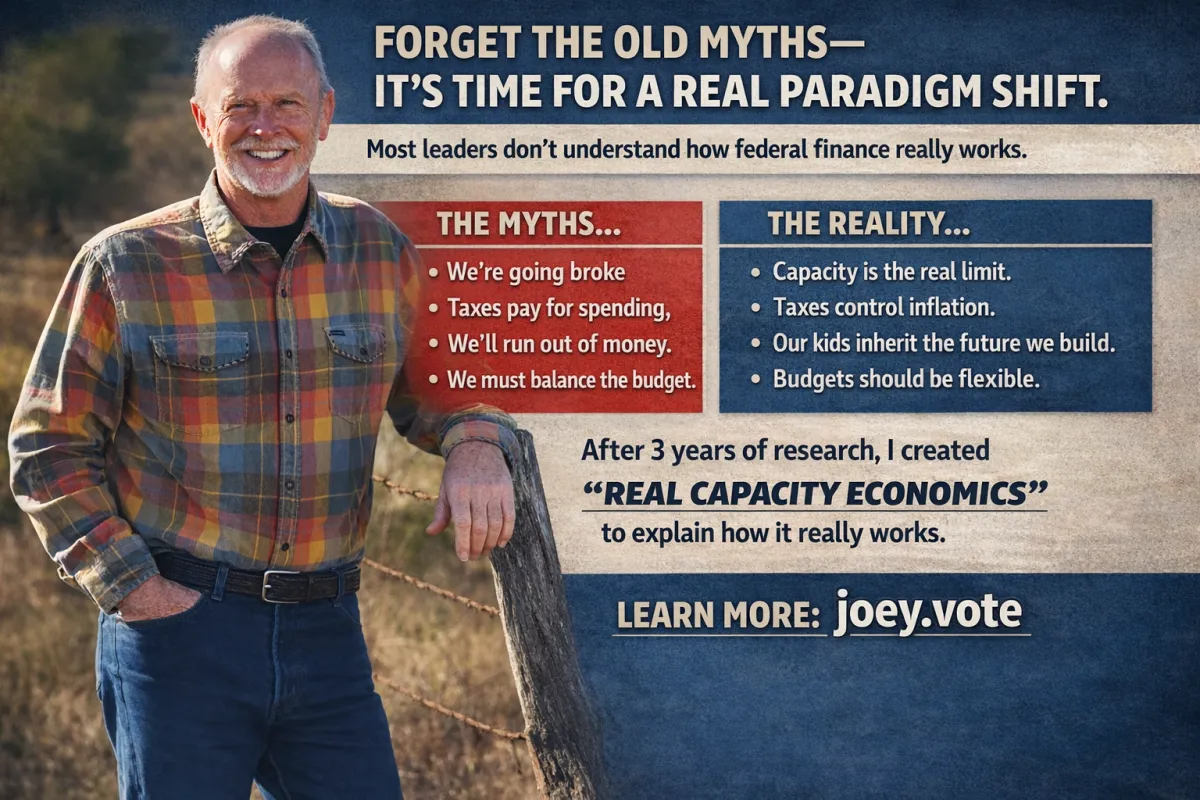
What Real Capacity Economics (RCE) Really Means
A Needed Paradigm Shift
What I’m about to share requires a real shift in thinking. Not a small tweak, but a true change in the lens we use to understand how our federal government operates. I’ll be honest with you. When I first encountered these ideas, they didn’t fit anything I had been taught about budgets, taxes, or national debt. They didn’t line up with what politicians argue about on TV. And they sounded almost too simple.
So I spent the last three years digging in, researching, reading, questioning, and educating myself. I talked with economists, listened to experts, and went back to the raw mechanics of how our monetary system actually works. What I found was both surprising and freeing. It became clear to me that the way we talk about government finance is completely different from how it actually functions.
That’s why I named and developed Real Capacity Economics, or RCE. It’s my way of helping regular people understand a system that far too few leaders truly grasp.
What Real Capacity Economics (RCE) Really Means
RCE begins with one basic truth.
Because the US has a fiat currency the federal government’s limit IS NOT money. We can print all the money we want. The real limit is the economy's ability to absorb the dollars we print without causing a rise in inflation.
So at the core of RCE is the word "Capacity".
Capacity means our real-world strength
• the people who can work
• the skills they bring
• the tools and equipment available
• the factories and farms we operate
• the energy and technology that power our country
When these capacities are sitting idle, we still have room to grow.
This idea may sound new, but some major economic leaders have hinted at it.
Former Federal Reserve Chair Alan Greenspan openly said that Social Security checks can never “run out of money,” because the federal government creates the dollars it spends.
Former Fed Chair Ben Bernanke has said that taxes don’t “pay for” federal spending in the way most people imagine.
Economist Warren Mosler has explained many of the mechanics behind how modern monetary systems function.
But the truth is that most elected officials still don’t understand this. And that lack of understanding leads to bad decisions, unnecessary fear, and endless political theater. Worst of all, their lack of understanding has greatly impacted the countries ability to fund basic needs and has suppressed our growth.
RCE cuts through all of it by focusing on what actually matters: America’s real capacity to produce, build, grow, and serve.
Myth vs Reality: How Government Finance Works Under RCE
Myth 1: “The federal government must collect money before it spends.”
Reality: The federal government creates the dollars it spends. The limit isn’t money. The limit is capacity. If America has idle workers, unused factories, or underused resources, then there is room to invest without causing inflation.
Myth 2: “Taxes pay for federal spending.”
Reality: Taxes help manage inflation, not fund operations. Taxes remove money from the economy when it overheats. They guide behavior and keep prices stable, but they are not how the federal government “gets money.”
In RCE, taxes act more like a thermostat than a wallet.
Myth 3: “We’re burying our grandkids in debt.”
Reality: Our kids inherit the real country, not a spreadsheet. The true burden on future generations is whether we leave them strong infrastructure, healthy workers, modern technology, resilient supply chains, and a reliable energy system.
RCE keeps our eyes on the things that actually matter.
Myth 4: “The responsible thing is to balance the federal budget like a household.”
Reality: A federal budget is not a household budget. For a national economy, forcing balance during a downturn can deepen a recession. Real responsibility means supporting families and businesses when capacity is underused, and easing off when the economy is running hot.
Myth 5: “Creating new money automatically causes inflation.”
Reality: Inflation happens when we try to use more than we have. If spending goes where America still has room to grow, prices stay steady. If spending piles into areas already stretched thin, inflation rises.
RCE helps us avoid the bottlenecks and focus on real strengths.
In One Sentence
Real Capacity Economics, the framework I created, is a clearer way to understand the economy by focusing on America’s real ability to produce and grow, instead of outdated myths about money.
